contact us

Use the form on the right to contact us.

You can edit the text in this area, and change where the contact form on the right submits to, by entering edit mode using the modes on the bottom right.

Form Block
This form needs a storage option. Double-click here to edit this form, and tell us where to save form submissions in the Storage tab. Learn more
         

123 Street Avenue, City Town, 99999

(123) 555-6789

email@address.com


You can set your address, phone number, email and site description in the settings tab.
Link to read me page with more information.

Blog

5 FAQs About Startup Investments

Mihir Gandhi

Investing in startup businesses can be risky. Nine out of 10 new businesses fail, and many investors lose their money. However, there are still many reasons why this type of investment is worthwhile for both the entrepreneur and the investor. When considering the option of investing in a startup, there are many questions that potential investors ask. The most common of these are:

Why Should I Invest in a Startup?

Startup investing is risky and expected returns on investment can’t really be accurately calculated. However, fortune favors the brave, and if you understand and accept the risks, you stand the chance of making high returns. The benefit of diversification, of having alternative assets in a stock-heavy portfolio can’t be ignored. Some studies have shown that by allocating just 5% of your investment capital to private placements and the rest to stocks and bonds, you can expect up to 12% higher returns than by investing in stocks and bonds alone.

What is Crowdfunding?

Crowdfunding is a groundbreaking new opportunity that allows pretty much anyone (with some restrictions) to become an investor in a new business. In equity-based crowdfunding, investors receive shares in the business in return for monetary investment (from as little as $1000).

Are Startups Safe Investments?

No one can predict with any great degree of certainty which startups will succeed and which will fail. The important rule is to never invest more money than you can afford to lose. Even if the business does work, you won’t see an immediate return as all profits will be reinvested. Investing smaller amounts in many businesses is safer than a lump sum in one company.

Does the Startup Need Investment to Survive?

In some cases, “friends and family money” has gotten the startup off the ground, and capital is now needed for growth and expansion. If a business is already a proven concern, it’s a safer investment than a brand new startup.

What Kind of Exit Strategy Should I be Looking For?

You need to know what your likely exit, or disinvestment from the business will be. Is the startup likely to go the merger or acquisition route, or is an initial public offering a possibility in the future. Have a good idea of how you’re going to get your money out and buckle up for a fun ride.

For more information on how to become an accredited investor for a startup business, visit https://www.VerifyInvestor.com.

Private Placements - What You Should Know Before Investing

Mihir Gandhi

Many companies raise money through an initial public offering (IPO), but that's a costly and time-intensive process. A private placement offering is often more appropriate for private companies and smaller businesses that need to raise capital.

What is a Private Placement?

A private placement is a sale of a company's securities to a limited number of qualified investors. They are not offered to the general public and are exempt from the registration requirements of the Securities and Exchange Commission (SEC). Securities sold can take different forms, but they are usually either equity or debt. There's been a tricky new development. Under new Rule 506(c) of Regulation D, a private placement could actually be generally solicited and advertised while still being considered a private placement. The securities, however, may only be purchased by investors who have been verified as accredited investors.

Benefits to the Company

Private placements are a quicker, cheaper way to raise cash than a public offering, and are not usually subject to the onerous obligations affecting publicly listed companies. Companies typically have more control over the entire process and can decide how much to sell, at what price, and to whom.

Benefits to Investors

Securities obtained through public placement are generally alternative investments. In other words, they are investments that wouldn't normally be part of most portfolios. That means they also provide an interesting way to diversity the typical portfolios that might be typically dominated by large cap stocks and bonds.

Risks of Private Placement Investment

These types of investments always carry a high risk. The reasons for this are varied. Companies looking for private placement investment are usually less established. Private placement securities are also less liquid and may be subject to holding requirements.

Investing in private placements requires a high tolerance to risk, as well as low concerns over liquidity, and a willingness to take on long-term commitments. Investors should also be prepared for the worse case, although not uncommon, scenario, which is that they lose their entire investment.

Investment Tips

  • Do your homework - find out as much as you can about the company and the industry within which it operates.

  • Undestand the exit strategy - be prepared to have your capital tied up for a long time, but ask yourself how and when you will liquidate your securities.

  • Talk to your advisor - find out the risk factors, and ask how well this investment dovetails with others in your portfolio.

Rule 506(c) private placements are available only to accredited investors that have been verified. Get verified safely and securely with www.VerifyInvestor.com.

Our Terms of Use and Privacy Policy Have Been Updated

VerifyInvestor.com

We just wanted to let you know that we updated the Terms of Use and Privacy Policy for VerifyInvestor.comwww.VerifyInvestor.com.  

The new Terms of Use can be found through this link: https://www.verifyinvestor.com/terms

The new Privacy Policy can be found through this link: https://verifyinvestor.com/privacy

Of course, you can always access the latest version of both our Terms of Use and Privacy Policy by visiting our homepage and clicking through the appropriate links on the bottom.

We don't expect that you'll have any issues with the new policies.  Nevertheless, please do take the time to read them.  In general, they provide greater clarification of existing policies.  We had a company who was concerned about confidentiality and privacy of their investors and wanted to see more specific language in our Terms of Use and Privacy Policy.  We agreed with them and wanted to give all of our users the benefit of the changes we were willing to make for them.  If you're unclear about anything or have any questions, please don't hesitate to contact us.

Investment Funding Opportunities Under the JOBS Act: Title II

Mihir Gandhi

If you're an accredited investor or the owner of a small business, Title II of the Jumpstart Our Business Startups (JOBS) Act holds significant benefits for you in terms of investing and advertising for funding. The new regulations under Title II and Rule 506(c) of the Securities Act give investors and businesses the freedom to profit from or raise capital through private offerings involving general solicitation.

Positive Impact of Title II

In 2013, the formal implementation of Title II of the JOBS Act lifted the ban on general solicitation for small companies and startups. To adhere to the changes under Title II, the United States Securities and Exchange Commission (SEC) added Rule 506(c) of Regulation D, which outlines the sale and purchase of private securities between issuers and accredited investors in generally solicited private placements. Previously, businesses and startups weren't able to utilize any public advertising methods when conducting private placements, causing them to miss out on reaching many potential investors. With these new provisions now in full effect, business owners have the freedom to advertise for and obtain the crucial funding they need.

Advertising Publicly for Capital

General solicitation is the practice of using public mediums to solicit and advertise for investment capital. The Securities Act of 1933 placed a ban on general solicitation to combat the possibility of fraud. Before Title II of the JOBS Act and Rule 506(c) lifted the ban, the laws made it exceedingly difficult for business owners in need of investment capital to seek growth capital. Businesses and startups are now free to use any means of public advertising, such as crowdfunding sites, ads, social media, etc., when raising capital through a private placement.

Investor Advantages

While the ban was originally intended to keep investment scams at bay, it also negatively impacted opportunities for purchasers to build their portfolios. Now, because issuers are allowed to publicly solicit for funding while still engaging in private offerings, accredited purchasers have the freedom to invest in more businesses. Just as businesses have the opportunity to raise capital through general solicitation, investors benefit by having the ability to broaden their portfolios, support promising businesses, and earn more substantial profits.


Our Terms of Use and Privacy Policy Have Been Updated

VerifyInvestor.com

We just wanted to let you know that we updated the Terms of Use and Privacy Policy for VerifyInvestor.com.  

The new Terms of Use can be found through this link: https://www.verifyinvestor.com/terms

The new Privacy Policy can be found through this link: https://www.verifyinvestor.com/privacy

Of course, you can always access the latest version of both our Terms of Use and Privacy Policy by visiting our homepage and clicking through the appropriate links on the bottom.

We don't expect that you'll have any issues with the new policies.  They've only been updated to reflect how our users have told us they want to use our service.  Nevertheless, please do take the time to read them.  If you're unclear about anything or have any questions, please don't hesitate to contact us.


[Infographic] Jumpstart Our Business Startup Act

Mihir Gandhi

ABOUT THE JOBS ACT

The JOBS Act was created with small businesses in mind, giving them greater opportunities to raise capital under new regulations that allow general solicitation and advertising. The U.S. Securities and Exchange Commission (SEC) implemented final rules regarding general solicitation and advertising as required by Title II of the JOBS Act. Those rules went into effect on September 23, 2013 and allowed private startups and businesses to publicly solicit for investments -while still qualifying them as private placements. While the ban on general solicitation and advertising was lifted, investors still need to be verified as accredited in order to purchase securities.

JOBS Act: Beneficial Provisions for Purchasers & Issuers

Mihir Gandhi

A remarkable feature of the economy of the United States is that in the 30-odd years prior to the most recent recession, young companies (no more than five years old) created almost all of the new jobs in the private sector. If history repeats itself, and it usually does, we need to see the formation and growth of more and more new businesses if we want to see sustained economic recovery and development in this country.

This is a large part of the reason behind the passing of the Jumpstart Our Business Startups Act (JOBS Act) in April 2012. It allows new businesses to raise the startup and growth capital they so desperately need by accessing public markets and soliciting investment without having to pay potentially crippling transaction costs. This benefit alone could be enough to inspire entrepreneurial risk takers to launch and grow their own businesses - and this is very much what the US needs.

Benefits for Issuers

  • Certain businesses can apply for Emerging Growth Company (EGC) status, which allows them to access the public markets while being exempt from having to comply with several costly regulations.
  • The act lifts the ban on general solicitation and advertising for certain types of private placements, making it far easier for businesses to find investors.
  • The act raises an exemption that previously was capped at $5 million to $50 million; in doing so, it also gave new life to an exemption that was previously largely unused.
  • Companies can now have up to 2000 shareholders (previously the limit was 500) before having to register with the SEC.

Benefits for Purchasers

Previously, investing in startups and private placements was generally unavailable to the general public. The JOBS Act makes it easier for deals to reach the marketplace, and therefore it also makes it easier for more people to access these deals and invest in them.

Of course, with all the changes that allow companies to solicit and sell to more of the general public, there is an increased risk of fraud. It's important to understand that the new laws made it easier for companies to tap the capital markets and for investors to find and invest in deals. The new laws, however, generally still require anti-fraud compliance. Essentially, companies must provide all material information to prospective investors that a reasonable investor would want to know prior to making an investment decision.

While the JOBS Act doesn't get everything perfect, it is a step in the right direction. With time, amendments to the JOBS Act will make it more useful and beneficial for both issuer and investors.

Investor Accreditation & Private Offerings Under Rule 506

Mihir Gandhi

Last year, provisions put in motion by the Jumpstart Our Business Startups Act (JOBS Act) were finally adopted by the Securities and Exchange Commission (SEC) which made it easier for entrepreneurs to fund their businesses through general solicitation of accredited investors. Startups and expanding companies are now legally able to fundraise without running into harsh restrictions on public advertising. However, issuers are still expected to abide by certain terms, which are laid out in Rule 506(c) of Reg D.

Easy & Affordable

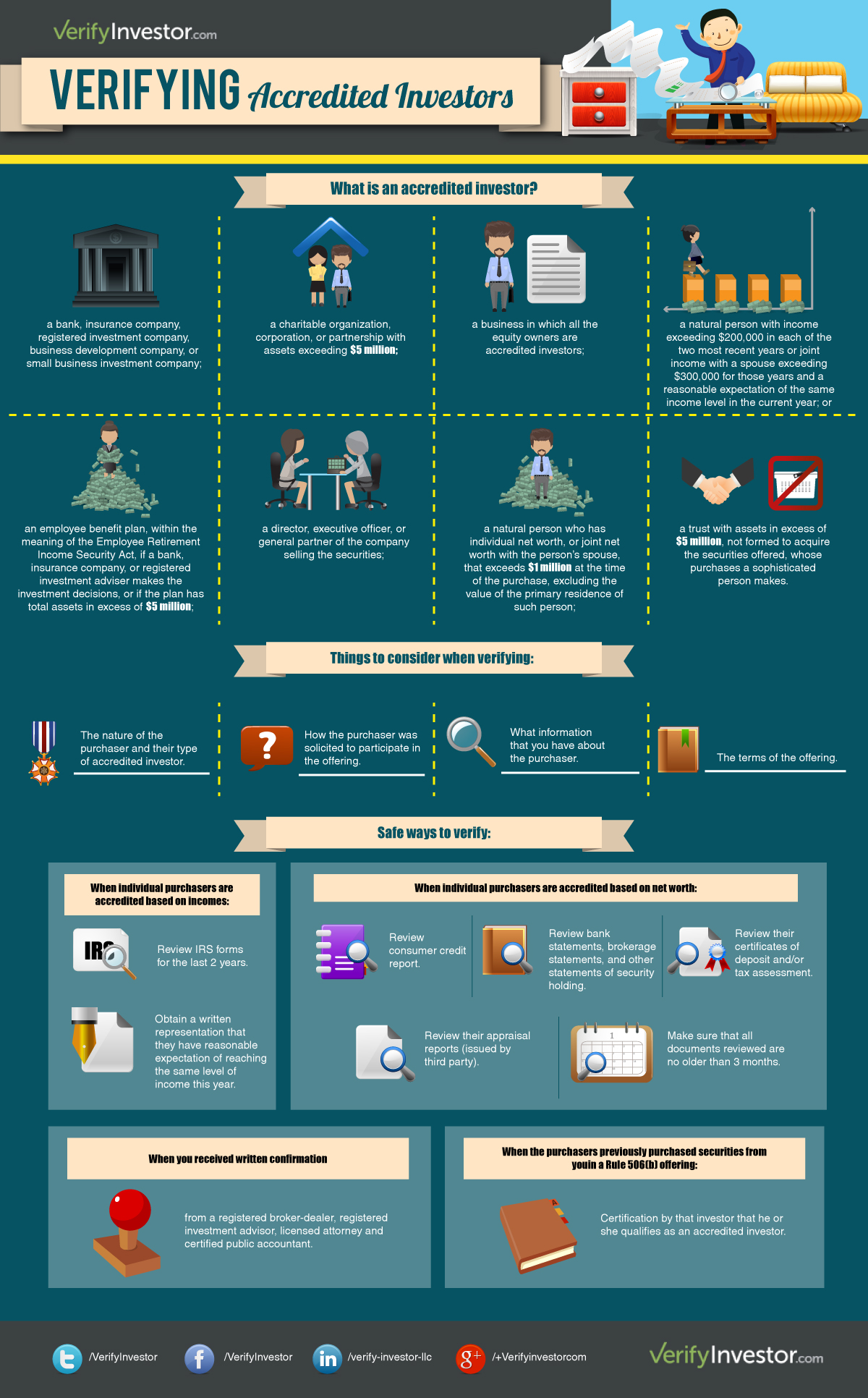
Per the JOBS Act, investors purchasing securities in private offerings with startups and small businesses that have generally solicited for the capital raise must all be accredited investors. The burden is on the issuer to take "reasonable steps" to verify that their investors are all accredited investors. The SEC does not set forth any specific requirement that an issuer must take to validate an investor, but does provide a list of non-exhaustive steps issuers can take to meet the "reasonable steps" requirement that they impose. The SEC stipulates that verification by licensed professionals and third-party verifiers may be legally-compliant certification methods.  While this may seem expensive, there are affordable options available in the marketplace as well.

Significance of Accreditation

Obtaining proof of accreditation is important because it helps to protect both issuers and investors. General solicitation was originally banned to prevent instances of fraud; however, as times have changed, not publicly advertising for investment capital was no longer practical for US companies. After Title II of the Jumpstart Our Business Startups Acts was signed into law by President Obama, new regulations were added to the securities laws, particularly to Rule 506. Rule 506(c) was added to lift the general solicitation ban, which had previously prohibited businesses from using public fundraising tactics.

Obligations of Issuers

The need for issuers to take "reasonable steps" is outlined in the amendment of Rule 506. In essence, to ensure investors are certified, business owners offering private securities should proactively seek verification before proceeding with a sale of their securities. As stated above, there is no single "safe harbor" that is required to be used to obtain proof, but the SEC mandates that issuers or third-party reviewers evaluate investors to make sure they meet the standards for accreditation. Typically, income, taxes, assets, net worth, and existing investor accreditation are reviewed to determine investors' statuses.