There is More than $4 Trillion Waiting to Be Invested
VerifyInvestor.com
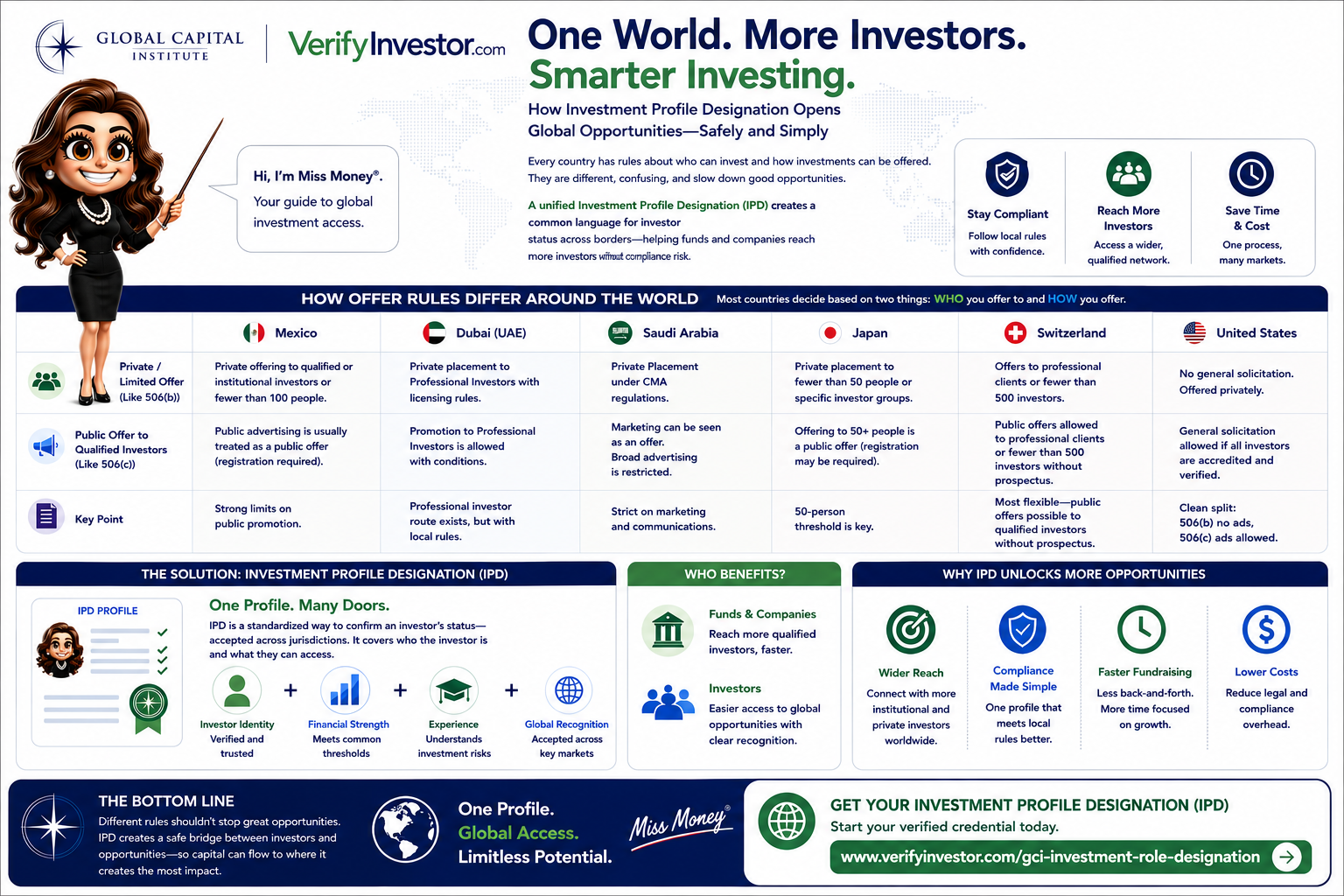
There is more than $4 trillion waiting to be invested.
So why do so many legitimate companies still fail to raise capital?
Those two facts cannot both describe a healthy market. Trillions of committed capital on one side. Real businesses on the other. Yet the two routinely miss each other. Everyone involved has a theory about why, and all the theories are wrong in the same direction.
In most markets, that’s the point where economists start to feel uneasy.
Exhibit A: The money
Private equity firms today sit on roughly $2.5 trillion of committed capital. Add venture capital, private credit, infrastructure, and real assets, and global dry powder clears $4.6 trillion, according to PitchBook. This is not hypothetical money in someone’s aspirational spreadsheet. Committees have met. Mandates have been drafted. Fees are being paid whether the money moves or not — which, incidentally, is the one part of this system that never experiences friction.
The money has done everything except its actual job.
Invest.
And yet, week after week, business owners, independent sponsors, and advisers repeat the same sentence:
“There’s just no capital out there.”
If that were true, it would be depressing. Because it’s false, it’s more interesting.
The Federal Reserve’s 2025 Small Business Credit Survey has the receipts: only 46 percent of applicants got the full amount they asked for; 22 percent got nothing; businesses applying for SBA‑backed loans were denied 45 percent of the time — more than double the rate across all loan types. Black‑owned businesses were denied 39 percent of the time, against 18 percent for white‑owned firms with comparable credit profiles.
And that’s just the people who applied. The Fed keeps a separate tally for “discouraged borrowers” — businesses that needed money and didn’t bother, because they had already decided the answer was no. Nobody knows how big that group is. Declining to show up doesn’t generate a data point.
So on paper, there is too much capital. On the ground, there is never enough. Between those two realities lies the real story.
Exhibit B: The scam
Consider one small case study.
A friend of mine recently lost just over $1 million.
Before you picture wiring money to a Nigerian prince, revise the scene. This didn’t happen in a spam folder. It happened in meeting rooms.
He’s an experienced independent sponsor. Years of deals. The sort of person compliance departments like to call “a sophisticated party” — which, it turns out, is not the same as an observant one.
A private investment fund from Switzerland expressed interest in a nine‑figure transaction. Its executives flew to the site. They toured the facilities. They questioned management. They reviewed financials. They negotiated terms and produced documentation that would have looked perfectly normal in any data room.
Nothing about this resembled a cartoon scam. No typos. No improbable urgency. No “dear sir” emails. Just polite professionals who spoke the right language and asked the right questions.
Eventually, they asked that certain transaction‑related payments be routed through digital wallets. Somewhere between those wallets and the devices that controlled them, $1 million disappeared.
The fund, the executives, the transaction — none of it had ever existed. Everything was counterfeit except the loss.
The obvious response is anger. A more useful one is unease.
He is one data point inside the $8.6 billion the FBI logged in investment fraud last year, the single largest loss category it tracks, inside a system where total reported losses hit $20.9 billion — a 26 percent jump in a single year. Older Americans lost $7.7 billion of that, up 59 percent.
The number climbs every year. So does the number of task forces formed to lower it.
Zoom out, and the fraud starts to look less like a freak event and more like a clue.
Imagine air traffic control designed this way
Change industries for a moment.
Imagine if commercial aviation worked like private capital. Thousands of aircraft. Thousands of airports. Plenty of fuel, plenty of passengers. But no radar. No transponders. No shared identity system. Pilots would spend their careers re‑introducing themselves to one another before takeoff. Every flight plan would begin with a warm introduction. Every safe landing would feel like a triumph of networking.
We wouldn’t call that infrastructure. We’d ground the fleet.
Yet that’s roughly how private markets still behave. There is no global, credible way to answer three basic questions at scale:
Who is this?
Can they do what they claim?
What’s their history?
Private capital likes to think of itself as sophisticated. For an industry that allocates trillions, it’s remarkably bad at answering the first question every transaction depends on: Who are you?
Markets confess their weaknesses
Markets are surprisingly honest.
They confess their weaknesses in the industries they build to route around them.
If thousands of conferences exist, the market can’t efficiently connect participants. If placement agents thrive, the market can’t efficiently transfer confidence. If investor databases proliferate, the market can’t efficiently identify who is who. If verification and diligence firms multiply — and they have; there is now an entire sub‑industry billing by the hour to confirm what a functioning market should already know — then legitimacy has never been standardized.
Markets don’t build billion‑dollar industries around solved problems. They build them around expensive uncertainty.
For years I described this as a trust problem. It isn’t. Or at least, trust isn’t the primitive.
Private markets still run on social discovery — dinners, reputations, who‑knows‑whom — standing in for the systems every other mature market eventually builds. Trust is personal. Social discovery doesn’t scale.
The result is an economy that keeps trying to solve an infrastructure failure with more relationships.
From indexing to social discovery
The internet didn’t create information. It made information findable.
Amazon didn’t invent products. It made them searchable.
LinkedIn didn’t create professionals. It made them findable without an introduction.
Bloomberg didn’t create securities. It made them visible.
Every great market expansion begins with the same move: reduce the cost of discovery.
Then, private capital.
Private market participants remain largely socially discovered — found at the speed of a calendar instead of the speed of a query.
Conferences are social discovery. Placement agents are social discovery. Investor databases are social discovery. Spreadsheets titled “Top 200 Family Offices” are social discovery. So is roughly 200,000 companies’ worth of the U.S. middle market — companies generating $10 trillion in revenue and employing 48 million people, according to the National Center for the Middle Market — still getting found mostly by who happened to sit next to whom at a conference dinner.
It’s 2026 and the state of the art is still a warm introduction.
The visible losses, and the invisible ones
Regulators can at least count a fraction of the price. The FBI’s $8.6 billion. The average private equity holding period stretching to nearly seven years before exit, almost double the roughly four years typical in 2007 — because sponsors can’t move capital in or out at the pace the diligence and trust‑rebuilding now demands. Bain put the resulting backlog of unsold, PE‑owned companies at roughly 32,000 as of 2026, worth an estimated $3.8 trillion.
Those are the harsh numbers. They’re also the easy part, because somebody, somewhere, was willing to publish them.
The invisible losses are almost certainly larger, and nobody has built the index that would let us count them.
We don’t know how many profitable companies quietly shelved expansion because financing never materialized. We don’t know how many acquisitions collapsed after months of diligence simply because the right capital never found them. We don’t know how many of the world’s estimated 8,030 family offices, managing a combined $5.5 trillion, walked away from real opportunities because verifying them demanded too much bespoke detective work. We don’t know how many founders quietly concluded that outcomes depend more on introductions than fundamentals, and looked elsewhere.
We don’t know how many jobs were never created. How many factories were never built. How many technologies arrived years late, or not at all.
None of that appears in a fraud statistic, because none of it was stolen — it just never happened. Stolen money at least existed, then got taken. That’s a story with a beginning. Capital that never finds a credible opportunity never even gets a story.
Fraud as an arbitrage
Seen through this lens, even fraud looks different.
The comforting story is that fraud is a moral aberration — a few bad actors, a few weak controls, solvable with a stronger onboarding form.
The less comforting story is that fraudsters aren’t creating uncertainty. They’re arbitraging it.
They profit from the fact that in one of the most sophisticated financial systems on earth, a well‑constructed imitation can move through the pipes almost as easily as a genuine counterparty — sometimes more easily, because genuine counterparties get asked more questions.
That’s exactly what you’d expect from a market that still discovers people socially instead of systematically: plenty of noise, plenty of room for mimicry, and a steady, quiet flow of profitable misunderstandings that never make the evening news because nobody involved wants to explain how a “sophisticated party” got taken for seven figures by a well‑dressed PDF.
Fraud isn’t the deepest failure here. It’s the most visible trade available on a more basic flaw — and it’s the only part of the flaw anyone is currently keeping score on.
What history might notice
Put the exhibits together.
Exhibit A: $2.5 trillion in private equity dry powder, $4.6 trillion once you count the rest.
Exhibit B: $8.6 billion in measurable investment fraud, out of $20.9 billion in total fraud losses, up 26 percent in a year.
Exhibit C: a scam sophisticated enough to fool a professional who does this for a living, on a nine‑figure deal, with site visits and a full data room.
Exhibit D: an entire ecosystem of conferences, placement agents, databases, and diligence firms — built, correctly, to route around a market that can’t answer “who is this” on its own.
Exhibit E: 200,000 legitimate middle‑market companies and 8,030 family offices, all supposedly looking for each other, still finding each other mostly by accident.
At some point, it gets hard to maintain the polite fiction that this is a fundraising challenge.
We often judge markets by the products they create. Judge them instead by the industries they need to compensate for what they cannot do. Markets don’t build billion‑dollar industries around solved problems.
Every mature market eventually replaces relationships with infrastructure — not because relationships stop mattering, but because they stop being the prerequisite for participation.
We indexed books.
We indexed companies.
We indexed people.
We even indexed the internet itself.
Yet in the one market where knowing who you’re dealing with is the entire game, we never quite indexed legitimacy — a strange gap to leave open in the one corner of the economy where legitimacy is the entire product.
Every market eventually solves its most expensive uncertainty.
Private capital hasn’t solved this one yet.
Which leaves one surprisingly primitive question at the center of a multi‑trillion‑dollar market:
Who, exactly, is on the other side of this transaction?