contact us

Use the form on the right to contact us.

You can edit the text in this area, and change where the contact form on the right submits to, by entering edit mode using the modes on the bottom right.

Form Block
This form needs a storage option. Double-click here to edit this form, and tell us where to save form submissions in the Storage tab. Learn more
         

123 Street Avenue, City Town, 99999

(123) 555-6789

email@address.com


You can set your address, phone number, email and site description in the settings tab.
Link to read me page with more information.

Blog

[Event] Dynamic Capital Presents: CROWDFINANCING REAL ESTATE

VerifyInvestor.com
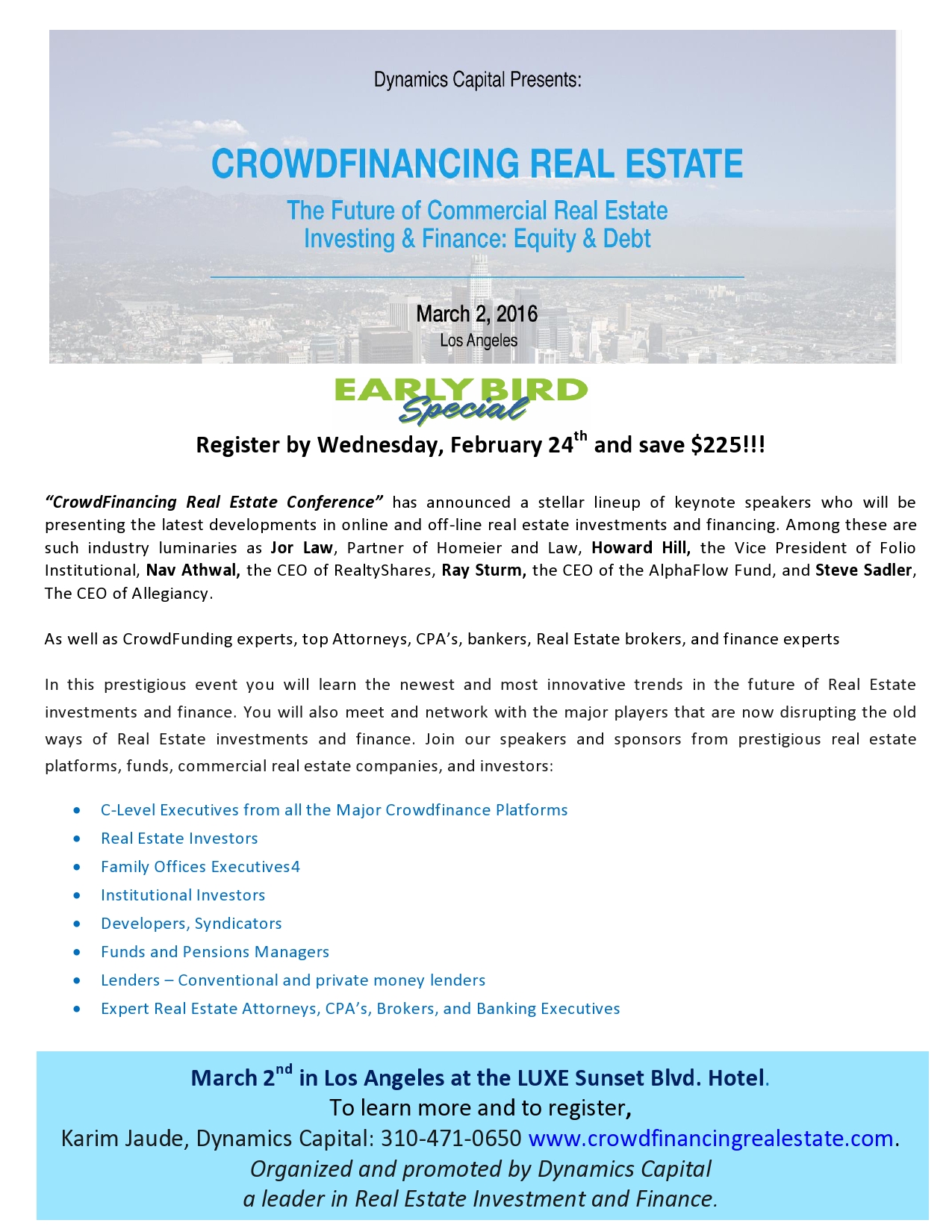
The Future of Commercial Real Estate
Investing & Finance: Equity & Debt

March 2, 2016

Los Angeles

Conference Agenda

In this extraordinarily valuable commercial real estate conference, you can expect to hear the answers to these questions from professional experts in online and offline real estate investing and financing.

    • Which online Real Estate platforms offer the best (and safest) returns?
    • Will platforms like RealtyMogul, PatchofLand, and RealtyShares continue to pay high interest to shareholders?
    • In a major downturn, will the major platforms have epic defaults? What will happen to those online platform’s investors?
    • Are any online platforms in danger of failing now and taking investors with them?
    • Will online platforms compete with Private Equity and Hedge Funds anytime soon?
    • Are there already too many online Real Estate platforms or will there be many more to come?
    • Will the low cost of debt change anytime soon?
    • Will the success of the Fundrise REIT be a game-changer?
    • In the near future will equity investments in Reg A+ offerings like Allegiancy’s replace real estate loans?
    • Will the major RE platforms like RealtyMogul, PatchofLand, RealtyShares, and others be acquired or go public?
    • Can the new SEC Crowdfunding rule (Title III) be used to finance smaller properties (up to $1MM) and will this rule bring non-accredited investors into real estate investing?
    • Is there a shortage of good deals or a shortage of money for the various traditional Debt, Alternative Debt, CMBS & Equity Markets Players?
    • Does the influx of foreign capital have any effect on the U.S. real estate market?
    • Is traditional Real Estate syndication still alive? Will it be replaced by online platforms?
    • What is the best way to structure real estate partnerships in this environment?
    • Will Private Equity and Hedge funds create their own online Real Estate Platforms?
    • What types of deals are the major private equity firms looking for?
    • How will the online platforms affect small brokerages?
    • How will online Real Estate investing affect the banks? Will they join in, like they have with peer-to-peer/marketplace lending?
    • Will the largest commercial real estate companies use online platforms to a greater extent?
    • Is online investing in real estate becoming a part of every portfolio? How does it rate as to safety against all other investments?
    • Will the platforms go to investments even smaller than $5000?
    • How will increased SEC scrutiny on real estate platforms and other deals affect the marketplace?
    • What future regulatory changes can we expect?
    • Are we witnessing a disruption in real estate financing, similar to what Google did to the Yellow Pages and Paper Maps?

Crowdfunding, Copycats & Protecting Your Idea

Mihir Gandhi

If you're exploring the idea of crowdfunding to raise capital for your venture, it means you have - or think you have - an original idea. Whether it is product, service or technology related, before you proceed further, you will want to ensure two things:

  • That you aren't unwittingly copying someone else's idea, and
  •  That others can't easily copy your idea

Read More...

Read More

Crowdfunding: The New Normal?

Mihir Gandhi

The crowdfunding phenomenon is not going away. It’s not just an American phenomenon, either, with economies across the globe increasingly participating in the democratization of raising capital. Crowdfunding’s rise over just the last few years demonstrates its increasing strength and dominance in the world of fundraising and capital acquisition.

Read More

Websites, Solicitation and the SEC’s Citizen VC No Action Letter

Mihir Gandhi

Citizen No Action Letter.jpg

The Internet age has arrived to capital raising, and that has forever altered the way businesses raise awareness about their investment opportunities. Balancing the digital age of investing with investor protection and the needs of business community is a key focus for lawmakers and the good folks at the Securities and Exchange Commission.

Rules 506(b) and 502(c) of Regulation D
Currently, Rule 506(b) of Regulation D is the mechanism that allows issuers to conduct a securities offering without having to register the transaction with the SEC, as long as it isn’t a "public offering". This means selling mainly to "accredited investors" (and not more than 35 non-accredited investors).  Private offerings using Rule 506(b) must also comply with Rule 502(c), which prohibits issuers from using general advertising or general solicitation to market their securities.

Unrestricted Websites
For those conducting Rule 506(b) offerings, in order to stay on the right side of the SEC rules, a publicly accessible website can profile general facts about your business but no information on the 506(b) securities offering. The types of information that will get you in trouble include predictions, projections, forecasts, valuation opinions, performance, and other information that may entice investor to invest in an offering. Unless you’re conducting a Rule 506(c) offering, unrestricted websites with any investment information on it are a bad idea.

Restricted Websites
Consider setting up a restricted-access website or area of your website that allows access only to accredited investors with whom you have a substantive relationship. This is an approach taken by firms like Citizen VC. Inc., who first work to establish a "relationship" with potential investors. Citizen VC sought clarification from the SEC that their approach would be seen as compliant. Here’s an excerpt from their letter to the SEC:

           "In order to apply for membership, Citizen VC requires all prospective investors, as a first   step, to complete a generic online "accredited investor" questionnaire. The satisfactory completion of the online questionnaire is, however, only the beginning of Citizen VC’s relationship building process."

The letter goes on to detail additional steps in Citizen VC’s "relationship building process" and to outline its own legal analysis of relevant sections of the Securities Act.

SEC Compliance & Disclosure Interpretation
The SEC published its response to Citizen VC on its No-Action, Interpretive and Exemptive Letterswebpage. In a nutshell, the SEC staff agreed that the approach outlined by Citizen VC in its August 2015 letter would not constitute general solicitation or general advertising within the meaning of Rule 502(c) of Regulation D.

The SEC wants to ensure that there is a "pre-existing" relationship with accredited investors before they a) are permitted access to the restricted area and b) are provided with any information about the offering. They’ve also made it clear that simply asking potential investors to "click a box" on a generic form will not suffice as a means to establish this pre-existing relationship.  The policies and procedures that Citizen VC undertook to evaluate the prospective investor's sophistication, financial circumstances and ability to understand the nature and risks of the securities to be offered led the SEC to concur that they had indeed developed substantive, pre-existing relationship with investors.

To view the No Action Letter, visit: http://www.sec.gov/divisions/corpfin/cf-noaction/2015/citizen-vc-inc-080615-502.htm

Don’t want to restrict your website and jump through hoops to establish a pre-existing relationship with your prospective investors?  Try a Rule 506(c) offering which allows you to publicly raise capital from anyone so long as you verify that the folks that end up investing are accredited investor.  Learn more at VerifyInvestor.com.

6 Reasons for Today’s Startup Boom

Mihir Gandhi

Record-breaking numbers of entrepreneurs around the world are starting their own businesses. Millions of people are forgoing the ‘job’ mentality and embracing their entrepreneurial spirit. There are little ecosystems of startup communities in nearly every major city in every industrialized country. The United States boasts almost half the global startups. Why is this happening?

1. U.S. vs. Global

The stage of economic development plays a role in volume, type and motivation for entrepreneurial startups. In the U.S., according to 2014 data from the Global Entrepreneurship Monitor, at least 13 percent of adults are starting and operating their own businesses. Where there is room for growth in the U.S. is in leveraging the global economy. GEM survey responses indicate fewer than 15 percent of U.S. entrepreneurs have a significant international customer base.

2. Opportunity Over Necessity

In the post 2008-recession, entrepreneurial motivation was reported as “necessity” – more people were starting businesses because they’d lost a job. Today, about 80 percent say they are motivated by opportunity in the economy.

3. Technology = Low Entry Cost

Technology is unquestionably the largest enabler of startup entry. The basic foundation for digital products and services are ubiquitous, cheap and flexible. The speed, universality and wireless nature of the Internet, the ease of cloud computing and access to tiny bits of code means an outsourcing and inexpensive smorgasbord for startups.

4. Social Media

An offshoot of technology, social media provides an interactive marketing and promotion platform at a fraction of the cost growing businesses used to have to spend on traditional advertising. A product invention or new service can be visible to the world with a small investment in a website and a few clicks of social promotion.

5. High Valuations

Valuations of a record number of privately held startups have hit $1 billion or more. As of June 2015, 66 of the 98 firms with valuations of $1 billion or more were American. There is no shortage of role models showing that it is indeed possible to become wealthy as an entrepreneur.

6. Demographics

Immigrants and boomers are both more likely to start businesses. According to the 2014 Kauffman Index of Startup Activity, immigrants to the U.S. started more than 28 percent of new businesses even though they represent just 13 percent of the population. And baby boomers between ages of 55 and 64 are starting more businesses than their Generation Y counterparts.

Under U.S. law, companies conducting capital raises under the new Rule 506(c) rules must verify investors to ensure they are accredited. Confidently bring investors on board with the help of the simple, reliable and confidential process offered through VerifyInvestor.com.